
Our expertise
Health literacy
Salutogenesis and health promotion within communities
Pathogenesis and risk prevention
Health and wellbeing of healthcare professionals at work
Working conditions and career pathways for nursing staff
Interactions between health, the environment and lifestyles

Our approach
The research and training activities of the teaching and research laboratory for community health prevention and promotion (LER PPSC) are based on an approach that considers the interactions between individual, social, environmental and organisational factors that influence the health and well-being of populations.
The laboratory’s research draws in particular on health promotion approaches. These aim to understand and strengthen the resources that enable individuals and communities to maintain or improve their health.
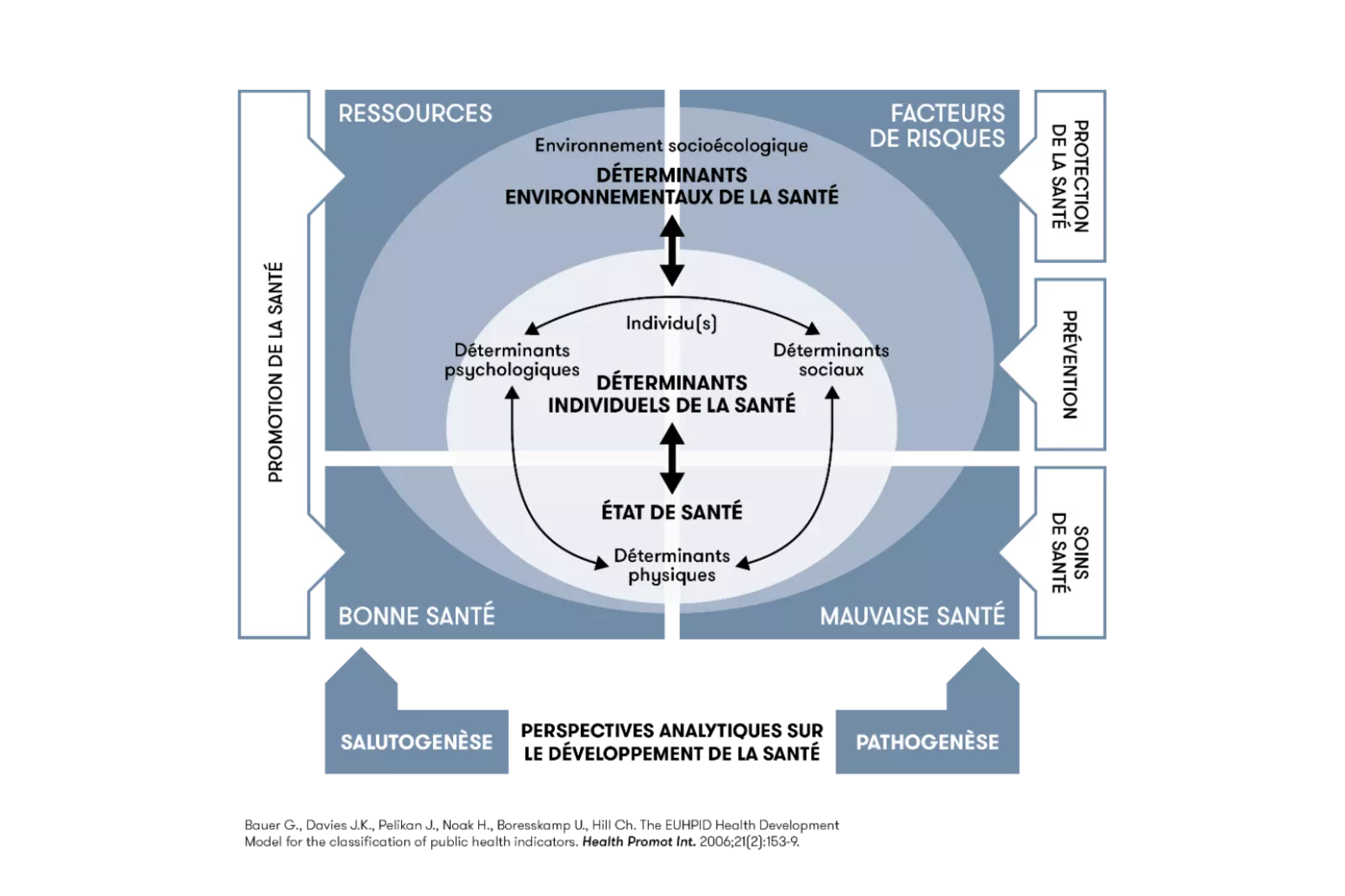
At the same time, particular attention is paid to identifying all the determinants of health and to developing interventions tailored to healthcare contexts, social realities and health challenges. To this end, the LER draws, amongst other things, on the model developed by Bauer et al. (see diagram below), which integrates salutogenesis and pathogenesis to explore the development and maintenance of health.
Our research generates knowledge that is useful to communities in the broadest sense: individuals, patients, young people, families, carers, healthcare professionals, institutions, schools, community organisations, strategic health bodies, etc.
What we do:
Identify emerging issues (young people’s mental health, caregiver burnout, staff shortages, misinformation and challenges related to AI, climate and health)
Explore the realities and lived experiences of specific groups (healthcare professionals, students, carers and vulnerable people)
Highlight health inequalities (access to healthcare, availability of information, working conditions, adverse environments and limited resources)
Produce new population-level data (e.g. SCOHPICA and ValPSY, EnvironMental)
Developing solutions based on real needs (digital tools, educational interventions, prevention programmes and policy recommendations)
The LER PPSC’s research projects
[AI-Lit] Artificial intelligence, literacy, healthcare professionals, digital skills: multi-professional study
[WB_Nurses_Gen] Nurses’ well-being and its determinants: a generational perspective
[AMCIA_2] Analysing multiple informant data on mental illness in children and adolescents
[ValPSY] Validating a web-based tool for diagnosing psychiatric illness in children and adolescents
[ACTiiV_Phase 3] Improving working conditions for nurses in the Canton of Vaud
[SCOHPICA_PdS] SCOHPICA Professionnels de santé, Swiss cohort of healthcare professionals and informal caregivers
[SCOHPICA_PA] SCOHPICA Proches aidants, Swiss cohort of healthcare professionals and informal caregivers VAUD, data and analysis
[ClimA] Impact of climate on ambulance emergency healthcare demands
[Symposium Climat et Santé 2026] Symposium – Climate change and health: roles and implications for health promotion and prevention stakeholders
Team
Annie Oulevey Bachmann professor at the University of Applied Sciences, scientific director of the LER
Bérénice Mathez Amiguet senior lecturer, managerial head of the LER
Stéphanie Casara Dumas lecturer
Shota Dzemaili lecturer
Sebara Gashi senior lecturer
Stéphane Joost geographer, PhD in Civil and Environmental Engineering from EPFL, accredited lecturer
Jonathan Jubin research fellow
Lisa Langwieser senior lecturer
Meichun Mohler-Kuo professor at the University of Applied Sciences
Philippe Pythoud senior lecturer
Coraline Stormacq senior lecturer
Séverine Vuilleumier professor at the University of Applied Sciences