Training alone is no longer enough: we need to bring the experience to life
Simulation has now established itself as an essential teaching method for effectively preparing healthcare professionals for the realities of the workplace. Whether integrated into continuing postgraduate training programmes or delivered as turnkey services it can be tailored to the specific requirements of each team and each institution.
Serving as a bridge to clinical practice, simulation enables skills to be developed gradually and safely. From initial technical procedures on manikins, to interaction with simulated patients right through to application in real-life situations, each stage is designed to ensure full integration of learning.
Interprofessional collaboration is central to this approach. By recreating realistic collaborative scenarios, simulation strengthens communication between professions, clarifies roles and improves the coordination of care.
Ultimately, professionals are better prepared, more confident and able to deal with complex situations as soon as they start practising, without putting patients at risk through inexperience.
A direct link between training and clinical settings
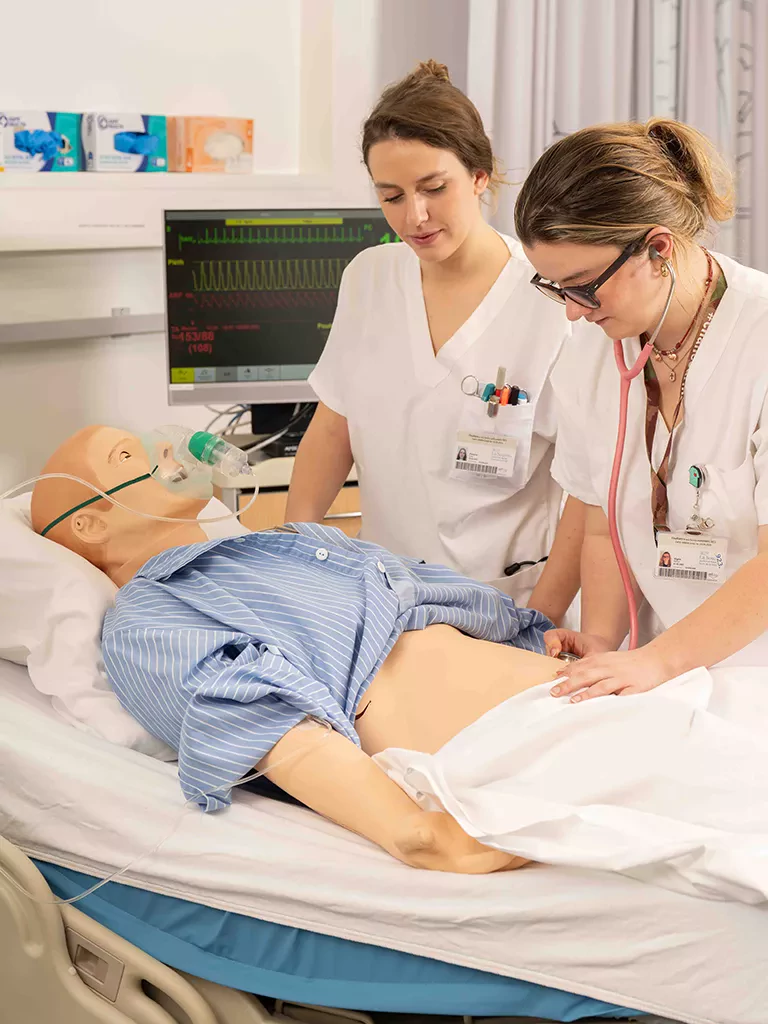
We work with clinical settings to provide simulations based on real-life situations.
Your teams, our facilities; a direct link to the front line
Training with us is beyond theory: it’s a hands-on experience. Your teams benefit from on-site services in an environment designed to faithfully replicate clinical situations.
alignment between institutions
We ensure that our protocols and methods are consistent with those of your organisations, ensuring continuity in both teaching and practice.
Experienced trainers at the heart of the learning process
Our practitioner-trainers support your teams during group sessions, encouraging the immediate transfer of skills and practical application in the field.
A fully immersive experience
From simulation and teamwork to real-world application, every stage is designed to prepare your professionals to intervene effectively, with confidence and in a coordinated manner.
What if training became a real experience?
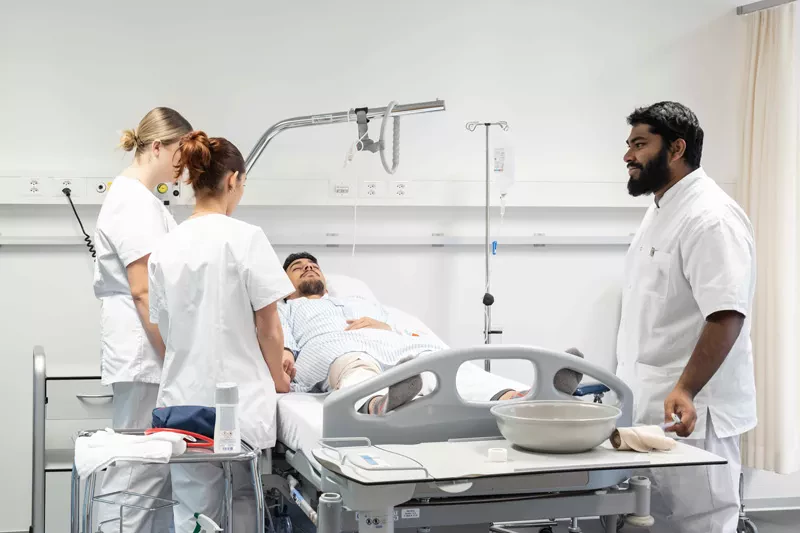
Thanks to immersive simulation, your teams are placed in realistic situations, drawn directly from real-world scenarios.
Teams are ready to put their learning into practice as soon as they return to work, with less anxiety and greater efficiency.
What are the four key stages of the simulation?
1. Writing – Developing the story
Setting objectives, creating a fictional patient and developing a realistic scenario with a clear timeline. This is where the learning experience begins.
2. Production – Laying the groundwork
Gathering all the resources: rehearsals with simulated patients, creating patient records, equipment and technology. A detailed stage to ensures an authentic immersive experience.
3. Implementation – Experiencing the simulation
Introduction, briefing, immersion in the scenario, observation and structured debriefing. This is the key stage of the programme, where the experience comes to life and learning is put into practice.
4. Evaluation – Continuous improvement
Analysis of the scenario, objectives, procedure and debriefing to refine the simulation and ensure the highest possible standard of teaching quality.
Why choose La Source for your simulations?
Expertise built up over time
La Source became involved in the development of healthcare simulation at a very early stage, recognising its crucial role in meeting training needs, addressing the growing complexity of care and overcoming the limited availability of clinical placement settings. With the creation of its first simulated hospital in Sébeillon, followed by the development of the simulated Hospital in Beaulieu in 2018, the institution has gradually built an immersive, structured learning environment that is fully integrated into the training programmes.
This expertise is not based solely on infrastructure. It relies above all on the skills of the teaching teams, lecturers and staff who design, implement and evaluate the simulation programmes. At La Source, scenarios are carefully designed, prepared, supervised and debriefed to the highest standards to ensure their educational relevance and safety.
La Source also has solid experience in interprofessional collaboration gained over several years through partnerships with various healthcare professions – notably healthcare assistants, medical students and paramedics. La Source’s expertise is fully aligned with the future challenges of healthcare. The simulation flats enable staff to practise scenarios relating to community healthcare, home-based support , residential care homes, an ageing population and continuity of care. Links with La Source at Home promote a practical exchange between clinical practice, teaching and patient experience, directly enhancing the learning process.
The realism of the scenarios is enhanced by careful attention paid to the environments, equipment, supplies, the simulated pharmacy and adapted or repurposed devices. This detailed knowledge of the site and its possibilities creates essential added value: enabling the design of credible, coherent experiences that closely reflect real-world situations.
What are the benefits of using simulated patients to train your teams?
Using simulated patients is a particularly effective way of enhancing your teams’ skills. Simulated patients help to improve interpersonal skills particularly in terms of communication, active listening and managing sensitive situations. They also provide immediate and personalised feedback enabling trainees to better understand the impact of their approach and to adjust their practices.
This method helps to build teams’ confidence by exposing them to a variety of situations, including rare or complex ones. It also encourages teamwork and coordination between professionals.
Incorporating simulated patients into your training programmes means investing in an immersive, practical and sustainable approach to learning which enhances the quality of care.